
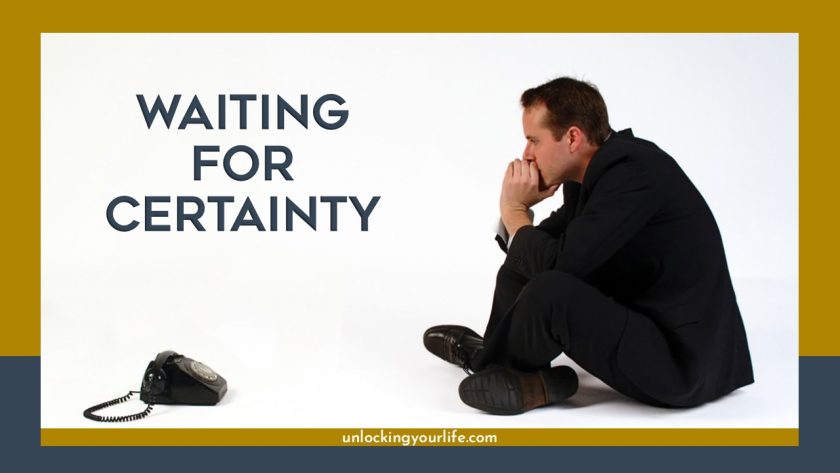
Waiting for Certainty Before Taking Your Next Step
By Dr. Scott Zarcinas, Founder, 818: Unlocking Your Life
When the Same Question Keeps Returning
You can spend a long time considering a change without getting any closer to making it. The question returns on the drive to work, while you are making dinner, during another conversation about how things have been. You imagine leaving the job, having the conversation, asking for help; then you return to the reasons it would be better to wait.
There may be sensible reasons for taking your time. Money matters. Other people may be affected. You want to understand the consequences before making a decision that changes your life.
The difficulty begins when every possibility has to provide an assurance that experience itself cannot offer.
You want to know how the decision will turn out before allowing yourself to take the next step.
At a crossroads, uncertainty can become the place where life remains suspended. The decision occupies your attention, while the days continue to pass around it. You may still be working, meeting responsibilities, caring for others, but inwardly you are waiting for the moment when moving forward will feel completely safe.

What Would You Need to Know?
It helps to examine what certainty would actually mean in your situation. If you are considering a different job, there are things you can find out: the salary, the hours, the responsibilities, the qualifications required. Those details can help you make a considered decision. Other questions, such as whether you will enjoy every aspect of the work or regret leaving, can only be explored through experience.
When these different kinds of questions become mixed together, research can continue indefinitely. You read another article, speak to another person, revisit the same advantages and disadvantages. Each answer produces another question because the underlying request remains unchanged:
You want the possibility of disappointment removed.
Consider someone who is interested in retraining. They can investigate the course, discuss the timetable with their family, calculate the expense, and speak to people working in the field. After doing those things, they may still feel uncertain. That feeling deserves attention, alongside the information they have gathered. It cannot, by itself, tell them whether the change is worthwhile.

The Conditions We Place on Moving Forward
Sometimes the most useful question is what we believe uncertainty says about us. You might assume that a responsible person would already know the right answer, that a confident person would feel no hesitation, or that an adult with your experience should have worked all this out by now.
Those expectations become another condition you must satisfy before beginning.
A crossroads can then become more than a decision about work or relationships. Your understanding of yourself becomes involved. Choosing differently may feel like admitting that an earlier choice was wrong. Asking for support may seem inconsistent with being the person everyone else depends upon. Remaining where you are preserves something familiar, even as your frustration grows.
These assumptions are worth examining in their own right.
- Where did you learn that changing direction meant failure?
- What makes hesitation seem like evidence that you are incapable?
A decision becomes harder to recognise when you are also trying to defend an image of who you should be. Understanding that pressure can help you see what the practical question actually requires.
🔍 Your Complimentary Prep Check
Are You Ready to Get Life Moving?
10 Questions to help you gain clarity and prepare for the changes you want to create >>
What Is Waiting Costing You?
Waiting has consequences, including when nothing obvious changes. You may notice how much energy goes into rehearsing the same conversation or imagining the same departure. Your attention is divided between the life you are living and the life you keep considering. Even enjoyable occasions can feel interrupted by the sense that something remains unresolved.
The cost may also appear in what you postpone. You tell yourself that you will relax when the decision is made, spend more time with friends when work settles down, or enjoy the weekend once you know where everything is heading.
The uncertainty surrounding one part of life begins determining how fully you participate in the rest of it.
This is a useful place to pause and ask what you have made dependent upon a future resolution. What would you allow yourself if the unanswered question remained for another month?
You may discover that some of the experiences you have postponed are available within your present circumstances. Giving them attention can also help you approach the decision with more perspective.
A Step That Helps You Learn
A way forward can begin with an action proportionate to what you currently know. Before deciding whether to leave a profession, you might arrange a conversation with someone in the field you are considering. Before making a major financial commitment, you might try a short course or explore the work on a smaller scale. The purpose is to discover something relevant to your situation.
The same approach can help in relationships. You may have spent months predicting how another person will respond to an honest conversation. Preparing what you want to say, choosing a suitable time, and expressing one concern clearly can reveal more than another evening spent rehearsing every possible reaction. Where safety is a concern, appropriate support and planning belong within that preparation.
A useful next step has a clear purpose and limits you understand.
Some questions you might want to ask:
- What do you hope to learn?
- What action is required?
- When will you review what happened?
This gives your attention somewhere practical to go. You can consider the experience afterwards, including what surprised you, what became clearer and what still needs further thought.

Recognising Your Crossroads
You may continue to feel uncertain after taking a step. Experience often makes some things clearer while revealing questions you had not considered. Progress can involve learning how to respond to that changing understanding, allowing what you discover to inform the next decision.
Begin by describing your crossroads in ordinary language. Name the change you are considering, the information you still need, and the assurance you have been hoping someone or something will provide. Then look at what waiting feels like in your daily life.
- What keeps returning?
- What are you putting off?
- What could you explore without committing yourself to the entire journey?
These questions bring attention back to your experience. From there, a conversation, a practical enquiry or a decision to seek support may become easier to recognise.
Your next step can be something you understand well enough to take and reflect upon; the rest of the route can become clearer as you participate.

Where Are You Waiting?
Our free six-question check-in can help you explore your crossroads and what you have been waiting for. Your result appears immediately; no name or email address is required.
For further reflection, get Find Your Way Forward, your free crossroads guide.
If you would like to discuss your situation, book a free 30-minute introductory session.


